Details
Book description
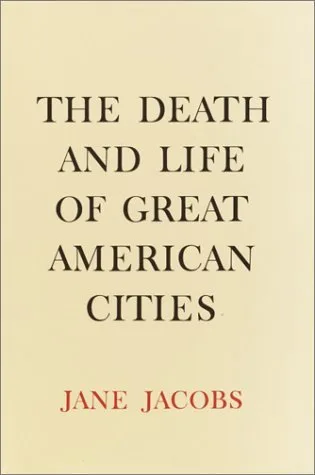
Jane Jacobs’s The Death and Life of Great American Cities is a landmark critique of conventional urban planning and a study of the conditions that help cities thrive. Drawing on close observation of urban life, Jacobs examines how streets, neighborhoods, and the wider city function—and how planning decisions can strengthen or undermine them.
The book considers practical questions with lasting importance: what makes a street feel safe, what defines a neighborhood, and what role neighborhoods play in the life of a city. Jacobs also explores why some areas remain impoverished while others renew themselves, connecting these outcomes to patterns of development, investment, and diversity.
Jacobs challenges planning approaches marked by short-sightedness and intellectual certainty. Her account emphasizes the value of varied urban uses and the everyday activity of city streets, while warning against excessive development investment and the loss of diversity. The result is both an argument about urban policy and a detailed framework for thinking about how city life works.
Written in direct, immediate prose, the book combines close attention to ordinary urban settings with a fundamentally optimistic case for understanding cities on their own terms. It is suited to readers interested in urban planning, architecture, neighborhoods, social science, and the forces that shape city life, as well as students and practitioners seeking a foundational perspective on urban vitality.