Details
Book description
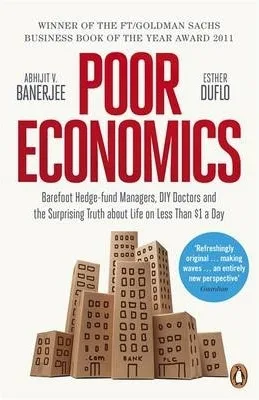
Why do people living in poverty make the choices they do, and which policies can genuinely improve their lives? In Poor Economics, economists Abhijit V. Banerjee and Esther Duflo examine questions like these by looking closely at the decisions and constraints that shape everyday life for the poor. The book challenges broad assumptions about poverty, arguing that good intentions alone are not enough to determine whether an intervention works.
Drawing on research associated with the Poverty Action Lab and fieldwork in India and elsewhere, Banerjee and Duflo make the case for testing anti-poverty ideas against evidence. Randomized control trials are central to their approach: rather than relying on sweeping generalizations, the authors investigate what happens when specific programs and policies are put into practice. Their examples consider subjects including food, education, household spending, and family size.
The result is an account of poverty that focuses on real choices and circumstances rather than treating poor people as a single, uniform group. The authors explore why outcomes may differ from what policymakers expect, and how careful research can help distinguish promising approaches from ineffective ones. The book connects individual decisions to larger questions about development policy and the use of public and charitable resources.
Written for readers interested in economics, global development, and poverty reduction, Poor Economics makes empirical research relevant to debates about how to help. Its evidence-focused perspective will appeal to students, practitioners, and general readers seeking a more nuanced understanding of poverty and the policies designed to address it.