Details
Book description
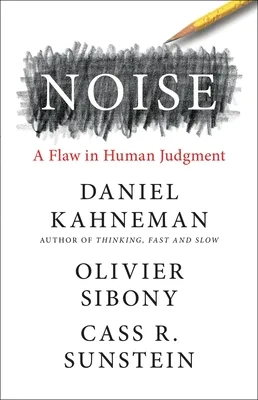
Noise: A Flaw in Human Judgment examines a hidden source of error in decision-making: unwanted variation in judgments that should be consistent. Daniel Kahneman, Olivier Sibony, and Cass R. Sunstein describe how two people can reach different conclusions about identical cases—and how even the same person may judge a case differently at different times. Such variation, which the authors call “noise,” can affect consequential choices across many areas of work and public life.
Drawing on examples from medicine, law, economic forecasting, forensic science, child protection, personnel selection, and other fields, the book explores how noise influences professional and organizational decisions. It explains why people and institutions may overlook this inconsistency, even when it leads to markedly different outcomes for comparable situations. The focus is not only on individual judgment but also on the processes and systems through which decisions are made.
The authors consider ways to reduce noise alongside bias, presenting practical remedies intended to help individuals and organizations make more reliable judgments. The book’s approach combines research-based analysis with accessible examples, connecting the study of human judgment to everyday institutional challenges. Its central concern is how to recognize avoidable variation and improve decision quality without assuming that every judgment can be made perfectly uniform.
Written for readers interested in psychology, behavioral science, management, law, medicine, and public policy, Noise offers a framework for examining decisions wherever human judgment matters. It is especially relevant to professionals and organizations seeking to understand why similar cases can receive different treatment and how more consistent decision processes might be built.