I, Tituba, Black Witch of Salem
PLUS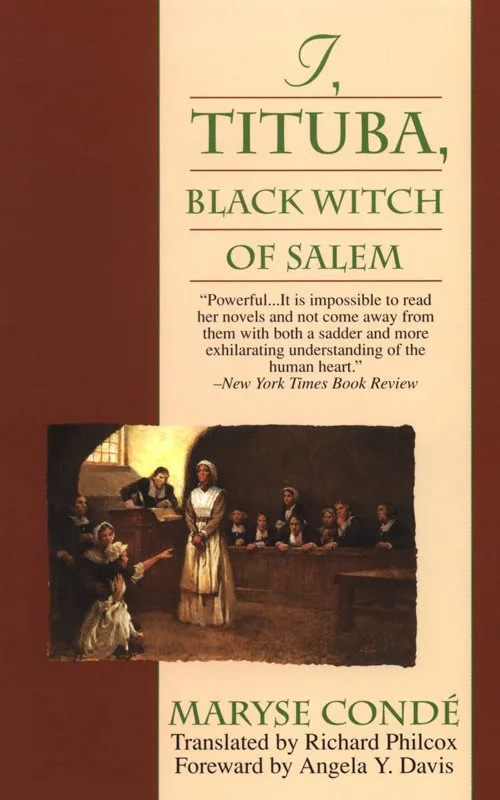
Details
Book description
Among the people accused of witchcraft in Salem, Massachusetts, in 1692 was Tituba, an enslaved woman from the West Indies. The historical record offers only a fragmentary outline of her life; Maryse Condé’s novel gives that fragment a fictional past, imagining Tituba’s childhood in Barbados and the circumstances that bring her to Salem.
The story follows Tituba from the Caribbean into a society shaped by enslavement and religious fear. Its historical setting connects the Salem accusations to the broader experience of a West Indian woman whose life is constrained by the people who claim power over her. Rather than treating Tituba as a name on the margins of the witch trials, the novel makes her the center of the narrative.
By blending historical material with imagined biography, Condé explores how race, gender, and status influence who is believed, condemned, or remembered. The book’s attention to Tituba’s perspective offers a counterpoint to familiar accounts of Salem and invites readers to consider the silences and distortions that can shape historical memory. Its subject matter also makes it a work of literary fiction concerned with colonial history and the human consequences of slavery.
This novel is suited to readers of historical and literary fiction, especially those interested in the Salem witch trials, Caribbean settings, and stories that revisit overlooked figures through imaginative reconstruction. It may also appeal to book groups and students seeking fiction that opens discussion about power, historical representation, and whose experiences are preserved in the past.